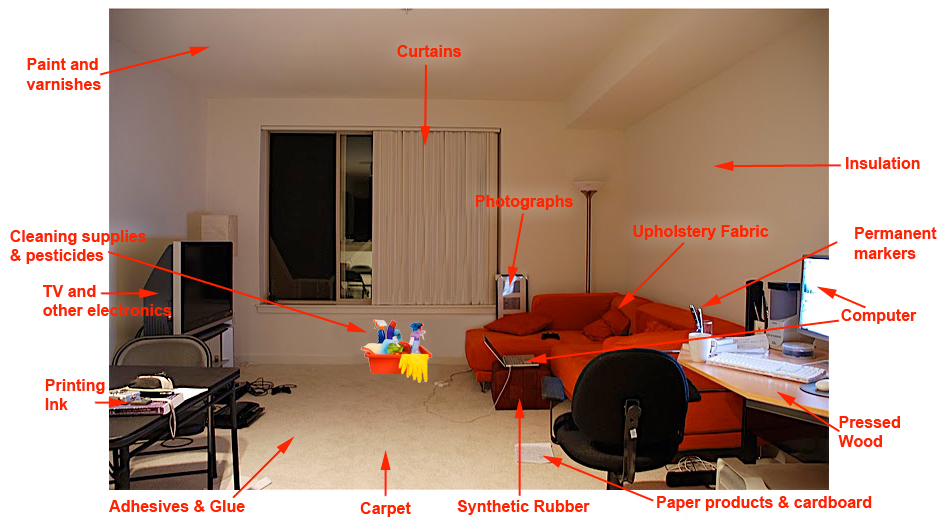
Volatile Organic Compounds

Chemicals that emit gas are called volatile organic compounds (VOC).
Chemicals that emit gas are called VOC. Another common term, Total VOC (TVOC) is a combined variety of organic chemicals that emit gas. They are measured in micrograms per meter cubed (µg/m3) of air, parts per million (ppm), or parts per billion (ppb). Most buildings will have TVOC levels ranging from 100-500 µg/m3 (Aerias). TVOC LEVELS AND POSSIBLE HEALTH SYMPTOMS TVOC Symptoms < 200 µg/m3 No irritation or discomfort expected 200 — 3,000 µg/m3 Irritation and discomfort may be possible 3,000 — 25,000 µg/m3 Discomfort expected and headache possible > 25,000 µg/m3 Toxic range where other neurotoxic effects may occur Source from Aerias Concentrations of many VOC are consistently (up to ten times) higher indoors than outdoors (US Environmental Protection Agency, 2010). Therefore, some VOC are regulated due to its short and long term affects on the health of humans. For example, the most common VOC is formaldehyde. On average, formaldehyde levels measured over a day in Canadian homes were 20-40 μg/m3 (16-32.5 ppb). Daily levels as high as 95 μg/m3 (77 ppb), however, have been recorded (Health Canada, 2009b). This chemical is strictly regulated by the Occupational Safety & Health Administration (OSHA) as it has been known to cause cancer. Table 2, below, lists a few common VOC along with the recommended exposure limit (REL) of the National Institute for Occupational Safety and Health (NIOSH), permissible exposure limit (PEL) of OSHA, identified symptoms if exposed to the chemical and some examples of products that contain the chemical. COMMON VOLATILE ORGANIC COMPOUNDS Chemical Exposure Limit Symptoms A Few ExamplesAcetone C3H6O NIOSH REL: TWA 250 ppm (590 mg/m3) OSHA PEL: TWA 1000 ppm (2400 mg/m3) Eyes/nose/throat irritation Headache Dizziness Central nervous system depression Nail polish remover Paint thinners Sanitary cleaner Arsine AsH3 NIOSH REL: 0. 002 mg/m3 [15-min] OSHA PEL: TWA 0.05 ppm (0.2 mg/m3) Headache Malaise Lassitude Dizziness Dyspnea Nausea Vomiting Lung & lymphatic cancer Semi-conducting materials Chemical warfare Benzene C6H6 NIOSH REL: TWA 0.1 ppm ST 1 ppm OSHA PEL: TWA 1 ppm ST 5 ppm Eyes/nose/throat irritation Dizziness Headache Nausea Anorexia Lassitude Leukemia Tobacco smoke Stored fuel Paint supplies Auto emission Laboratory solvent Formaldehyde CH2O NIOSH REL: TWA 0.016 ppm OSHA PEL: TWA 0.75 ppm ST 2 ppm Eyes/nose/throat irritation Coughing Wheezing Nasal cancer Carpet Pill capsules Disinfectant Preservative in vaccines Pressed wood Hydrogen Sulfide H2S NIOSH REL: 10 ppm (15 mg/m3) [10-min] OSHA PEL: 20 ppm - 50 ppm [10-min max peak] Eyes/nose/throat irritation Coma Conjunctivitis Dizziness Headache Lassitude Irritability Insomnia Crude petroleum Natural gas Hot springs Volcanoes Nitric Oxide NO NIOSH REL: TWA 25 ppm (30 mg/m3) OSHA PEL: TWA 25 ppm (30 mg/m3) Unconsciousness Eye irritation Drowsiness Wet skin/nose/throat Tobacco smoke Vehicle exhaust Vaccines Phosphine PH3 NIOSH REL: TWA 0.3 ppm (0.4 mg/m3) ST 1 ppm (1 mg/m3) OSHA PEL: TWA 0.3 ppm (0.4 mg/m3) Nausea Vomiting Abdominal pain Diarrhea Chest tightness Dyspnea Pulmonary edema Clothing Microelectronics PesticideStyrene NIOSH REL: TWA 50 ppm (215 mg/m3) ST 100 ppm (425 mg/m3) OSHA PEL: TWA 100 ppm C 200 ppm 600 ppm (5-min max peak in any 3 hrs) Eyes/nose irritation Headache Lassitude Dizziness Confusion Malaise Drowsiness Narcosis Reproductive effects Synthetic rubber Insulation Fiberglass Pipes Auto and boat parts Food containers Carpet backing Toluene C7H8 NIOSH REL: TWA 100 ppm (375 mg/m3) ST 150 ppm (560 mg/m3) OSHA PEL: TWA 200 ppm C 300 ppm 500 ppm (10-min max peak) Eyes/nose irritation Lassitude Confusion Euphoria Muscle fatigue Insomnia Paresthesia Dermatitis Liver/kidney damage Feedstock Paint solvents Gasoline Silicone sealants Printing ink Adhesives Disinfectants Xylene C6H4C2H6 NIOSH REL: TWA 100 ppm (435 mg/m3) ST 150 ppm (655 mg/m3) OSHA PEL: TWA 100 ppm (435 mg/m3) Eyes/nose/throat/skin irritation Dizziness Drowsiness Corneal vacuolization Anorexia Vomiting Abdominal pain Dermatitis Plastic bottles Polyester clothing Cleaning agents Paint thinner Paints & varnishes Gasoline Concrete sealers TWA = Time Weighted Average