Critical Environment Technologies
    June 8, 2018

    A Few Facts About Ozone
    A Few Facts About Ozone

    Classification Toxic, oxidizing agent, powerful disinfectant Molecular Formula O3 Molecular Weight 47.997 g/mol Fire Hazard Rating Risk of fire and explosion on contact with combustible substances M..

    ClassificationToxic, oxidizing agent, powerful disinfectantMolecular FormulaO3Molecular Weight47.997 g/molFire Hazard Rating Risk of fire and explosion on contact with combustible substances

    • May cause or intensify fireExplosion Range Neither explosive nor flammable on its own
    • Reacts explosively when shocked, exposed to heat or flame or by chemical reaction with organic substances/reducing agentsOzone

    ** ** Pure ozone is a bluish colour, when mixed with air it is colourless

    • Has a distinctive, pungent odour
    • Has a half-life of 12 hours in air, 3 to 20 minutes in regular water, up to 2.5 hours in high quality, double ozonation/filtration water
    • Pure ozone is heavier than air but it mixes completely with air and does not necessarily settle to the floor
    • Very reactive gas and will corrode most metals and damage most plastics and cause rubber to go brittle and crack
    • It is manufactured on site for immediate use because it is an unstable gas and decomposes quicklyToxic Effects of Ozone *NOTE: Long-term exposure to ozone *will not help you develop a tolerance to it; the nose rapidly loses its ability to smell ozone. 0. 01 ppm Odour threshold 0. 1 ppm May cause mild irritation of the eyes, nose, throat 0. 10 - 0.25 ppm Headache, dry cough, some reduction in lung function in 2 - 5 hours 0. 3 ppm Reduction in lung function during moderate work for all persons in 2 hours 0. 6 ppm Chest pain in 2 hours 1 ppm Lung irritation , severe fatigue in 1 - 2 hours 10 ppm Severe pneumonia (arc welders) with intermittent exposure 11 ppm Rapid unconsciousness in 15 minutes 50 ppm Expected to be fatal in 30 minutes Exposure Limits of Ozone0.05 ppm Maximum allowable concentration averaged over an eight-hour period for heavy work 0. 08 ppm Maximum allowable concentration averaged over an eight-hour period for moderate work 0. 1 ppm Maximum allowable concentration averaged over an eight-hour period for light work 0. 2 ppm Maximum allowable short-term exposure for less than or equal 2 hours 10 ppm Immediately dangerous to life and health (IDLH)Potential Causes of Leaks Equipment that is not inspected regularly or replaced when necessary leading to equipment malfunction
    • A destructor that isn't working properly
    • A pipeline blockage or clogged valve
    • Worn or damaged pipes, tubing, gaskets or valves
    • Using an incorrect material for joint sealers, pipes, valves, gaskets, diaphragms, tanks, sealants, etc.Ozone Generator RoomsNOTE: This is a general guideline. Follow local and appropriate codes/standards/regulations in your area to ensure proper compliance.

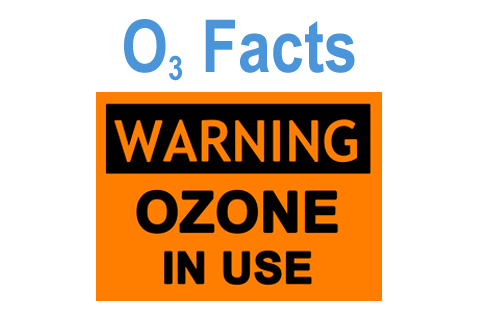
    Access should be restricted to authorized personnel only Posted at the entrance to the room should be a warning sign that ozone is present

    • Ventilation system with ability to provide required number of air changes for general ventilation and emergency ventilation
    • An emergency electrical shut off switch to manually shut off the power to the ozone generator must be located outside the room
    • Electrical switches controlling lighting and exhaust ventilation must be mounted outside the room
    • Room must be equipped with emergency lighting
    • Room with floor area larger than 40 m2 (430 f2) or longer than 10 m (33 ft) on any side, must have two exit doors to ensure accessible escape routes
    • All exit doors must open outwards and must be fitted with panic hardware (a crash bar for easy exit) and not be self-locking
    • All openings in ozone generator rooms (for example, in walls or ceilings) must be tightly sealed, including electrical conduits, access ports, monitoring apparatus, etc.
    • Do not store chemicals, solvents or any combustible materials in the ozone room
    • If the ozone generating system uses a pressure-fed ozone delivery system (compressor) to feed air into the generator, the room should not contain any auxiliary equipment
    • If the ozone generating system uses a vacuum ozone delivery system (venturi), the room may contain other operating equipment (such as sand filters, furnaces and pumps)
    • An ozone gas detection alarm system should be installed with an indicator located outside the room at each entranceProtection Continuous ozone detection and alarm system for early detection
    • Eye wash and shower facilities
    • Accessible shutoff valves, pump lockout procedures
    • Fully stocked first aid kits
    • Personal protective equipment including an escape respirator
    • All equipment should be protected against mechanical damage
    • Ventilation system and emergency ventilation exhaust systemEmergency Response Planning - steps to address an ozone leak Provide training, instruction and supervision
    • Write down safe work procedures
    • Have an exposure control plan in place
    • A written respiratory protection program that meets regulations
    • Regular worksite inspections
    • Legible and permanent identification on ozone generators and WHMIS workplace label required
    • After maintenance work and before operation, system must be appropriately vacuum tested or pressure tested to detect leaks
    • Have a maintenance schedule that outlines daily, weekly, monthly and annual inspections, testing, replacing and servicing equipment
    • Have breathing apparatus and protective clothing close by
    • Have emergency and evacuation procedures written down
    • Conduct scheduled emergency drills
    • Have procedure on how to notify emergency response units and adjacent worksites/homes
    • Conduct a formal investigate any time enough ozone is released to set off the alarmOzone Gas Detection System 24 hour continuous monitoring with an alarm response if ozone concentrations reach a certain pre-set level (at or below 0.1 ppm)
    • In alarm circumstances, the gas detection system should shut off the ozone generator and activate the emergency ventilation system (exhaust vents should be located well away from frequented areas)
    • The gas detector must be located beside the equipment and between the generator and the destructor; reaction tanks or destructors more than 5 m (16 ft) apart need their own gas detector
    • The ozone concentration in the exhaust air stream should be monitored regularly either with a gas detector or a detector tube
    • Tested at least on a monthly basis and calibrated at least annually by qualified personnel
    • Must have direct readout of the current gas level that can be seen from outside the room (at all entrances)
    • Audible and visual alarms should be located outside all entrances to the room and at another separate location in the building
    • Other gas monitoring devices such as detector tubes, test papers and air flow meters should be used in addition to a fixed gas detection system pdf version This document is for informational purposes only. No duty or undertaking is intended or assumed by CETCI. Every site is different and should develop and implement a health and safety program unique to their own operation. Always follow local, provincial and federal codes and regulations. If in doubt, contact the appropriate authorities.