
Formaldehyde is More Common Than You Might Think
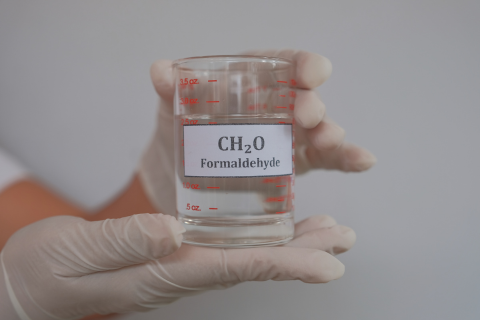
Formaldehyde is a chemical with no colour and an unpleasant smell. At room temperature it is a gas and it also comes in a liquid solution form. Formaldehyde can cause irritation of the skin, eyes, no.
Formaldehyde has many other names, such as, Formalin, Methanal, Methylene oxide, Oxymethane, Formic aldehyde, Methyl aldehyde. It is primarily used in the production of resins and adhesive and is found in many products such particle board, household products, glues, permanent press fabrics, paper product coatings, fiberboard, plywood, laminate and countertops. Beyond construction materials, Formaldehyde is a common laboratory chemical used as an embalming fluid, tissue preservative, sterilizer, fumigant or starting material for chemical synthesis. Formaldehyde is flammable and it reacts violently with strong oxidizers, hydrogen peroxide, potassium permanganate, acrylonitrile, caustics, magnesium carbonate, nitromethane, nitrogen oxides, and peroxyformic acid and is incompatible with strong acids, amines, ammonia, aniline, bisulfides, gelatin, iodine, magnesite, phenol, tannins, and copper, iron, and silver salts. Therefore, it should be stored in a manner that would prevent the possible comingling with these compounds. Formaldehyde is also a VOC (volatile organic compound) commonly found indoors in homes, schools and offices. A VOC is a type of chemical substance that can evaporate into a gas or vapor at room temperature. The primary way you can be exposed to formaldehyde is by breathing air containing off-gassed formaldehyde. The rate at which formaldehyde is released is accelerated by heat and can be affected by the humidity level. Using a dehumidifier and air conditioning to control or reduce humidity and to maintain a moderate temperature can help reduce formaldehyde emission. Many household items produce formaldehyde: Formaldehyde (CH2O) SolutionCigarettes (tobacco smoke) Always smoke outside, never inside. Cabinets & Furniture made of particle board or medium density fiberboard Buy these products covered with plastic laminate or coated on all sides. Humidity Levels Should be monitored; high humidity can cause products to release formaldehyde into the air. Permanent Press Clothing & Sheets Air out before use. Ventilation System Ensure proper ventilation is in place when using products that contains formaldehyde or any forms. Engines Don't run any kind of engine in spaces attached to your house or near any open windows and doors of your home. Fireplaces & Wood Stoves When in use, make sure proper ventilation is in place. For off gassing of formaldehyde, a TVOC gas detector can be used to monitor the area and provide real time data. Fixed CH2O gas detectors are common fixtures in medical labs and mortuaries where technicians are at high risk of exposure to formaldehyde as a vapour. It is crucial for occupational health and safety that the occupied space is well ventilated and monitored to ensure air concentrations never exceed safe limits.Formaldehyde (CH2O) Sensor Range 0 — 5 ppm Synonyms Formalin, Methanal, Methylene oxide, Oxymethane, Formic aldehyde, Methyl aldehyde TWA NIOSH = 0.016 ppm OSHA = 0.75 ppm STEL NIOSH = 0.1 ppm OSHA = 2 ppm ACGIH = 0.3 ppm IDHL NIOSH = 20 ppm Low Alarm Level 0. 3 ppm Mid Alarm Level 0. 5 ppm High Alarm Level 1. 0 ppm Short Term Exposure Irritation of the eyes, nose, and throat Coughing and wheezing as concentration increases Difficulty breathing when formaldehyde concentration is high Long Term Exposure Makes all symptoms worse Causes allergic reactions on the skin, eyes, and respiratory tract High levels can cause cancer in the nose, throat, or lungs