
Electrochemical Gas Sensors & Factors Affecting Life Expectancy
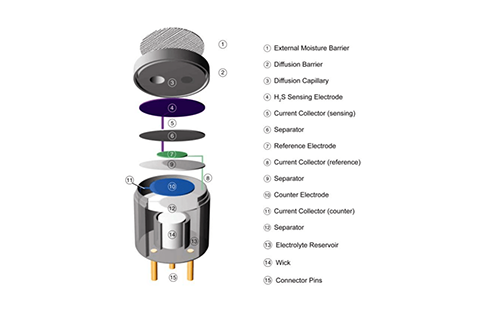
Electrochemical sensors are effective and offer very good performance for monitoring toxic gases and oxygen. Their lifespan depends on several factors.
Electrochemical sensors are designed to detect toxic gases and oxygen, and each sensor is relatively specific to its target gas. Toxic gases include gases like ammonia, carbon monoxide, nitrogen dioxide, chlorine, ozone, hydrogen sulphide, sulphur dioxide, ethylene, formaldehyde, hydrogen chloride and many others. When the sampled gas passes over the sensor an electrode converts a reaction of the gas being sampled into a measurable signal to calculate the concentration of the gas in the sampled environment. Using diffusion, target gases permeate a membrane located on the top of the sensor resulting in oxidation at the anode and reduction at the cathode. A current is created as the positive ions flow to the cathode and the negative ions flow to the anode. Gases such as O2, NO2 and Cl2 which are electrochemically reducible are sensed at the cathode while those which are electrochemically oxidizable such as CO, NO and H2S are sensed at the anode. With continuous usage, the electrode's responsiveness and accuracy will gradually decrease, and the electrolyte can dry out or become contaminated. Additionally, the membrane may deteriorate and become less effective. Environmental factors during storage, installation and operation can also affect the lifespan of electrochemical sensors. Factors Affecting the Lifespan of Electrochemical Sensors Typically designed to operate between -10°C and +50°C, do not exposed to extreme temperatures for prolonged periods of time. Repeated or prolonged exposure to temperatures like 60-65°C / 140-149°F can lead to evaporation of the electrolyte and shifts in baseline readings. Operation in very low temperature environments can impede the sensitivity of the sensor and slow its the response to the target gas. Continuous operation in low relative humidity environments can dry out the electrolyte and extended periods of exposure to high moisture environments can cause the electrolyte to absorb the moisture, causing dilution and inaccurate measurements. Prolonged exposure to extremely high gas concentrations can compromise sensor performance.
- Paint fumes, cleaning products, dust, sand, water, insects can reduce lifespan and compromise performance. Avoid exposure to high concentrations of solvent vapors during storage, installation and operation.
Organic solvents may block the sensing electrodes, create false baselines and in some cases damage the electrodes and physically damage the body of the sensor. Negative cross-sensitivities may cause the sensor to produce lower readings than the true concentration of gas in ambient air.
- Before initial use after production may be stored at room temperature ideally at 20°C / 68°F and 60%RH or preferably in the fridge for up to 6 months.
Beyond this period, the sensor performance is likely to deteriorate, such as with longer response time and lower sensitivity regardless of whether sensor has been used or not.
- The more exotic gases (chlorine, ozone etc.) tend to have shorter life spans than the more common gases (CO, nitrogen dioxide). Factors Specific to a Particular Toxic Gas AMMONIA (NH3): Background concentrations of ammonia might shorten the lifetime of the sensor.
Exposure to a high concentration all at once will poison the sensor and render it useless.
- CHLORINE DIOXIDE (ClO2): Negative cross-sensitivities may cause this sensor to produce lower readings than the true concentration of gas in ambient air. ClO2 sensors may underestimate the ClO2 concentration if hydrogen sulphide is present.
- ETHYLENE OXIDE (C2H4O): Should be zeroed on site if the ambient temperature is above 22°C (71.6°F).
This particular sensor has a drift factor that can be as much as 1 ppm if the temperature rises to 25°C (77°F).
- OZONE (O3): Sensitive and reactive to temperature and humidity changes, causing them to drift.
- HYDROGEN CHLORIDE (HCl): High humidity causes HCl absorption. Sensor should be stored with filter side facing down.
Storage time should not exceed 4 weeks.
- FORMALDEHYDE (CH2O): Abrupt changes in RH causes a short term transient signal. CH2O has moderate to high cross-sensitivity to other gases like hydrogen sulphide, isobutylene, phosphine, sulphur dioxide and hydrogen cyanide.
- OXYGEN (O2): Continuous exposure to high concentrations of sulphide compounds like hydrogen sulphide can poison the sensor. In addition to the factors listed above, most sensors will suffer general wear and tear and it may not always be easy to detect the damage caused, making regular maintenance important to help keep the sensors in good working order.
Regular maintenance includes inspecting, cleaning if necessary, bump testing and calibration.